What Did Process Art Reintroduce to Art Practice in the Early 1970s?
Articles and Features
A Brusque History of Digital Art: Between New Technologies & Innovative Artistic Practices
By Lucija Bravic
In today'south earth defined by technology, what does the term 'Digital Art' mean? Nosotros take a look at what the term actually refers to; how information technology differs from other contemporary art movements; who are the notable artists that accept left a mark in the field and some of today'south most experimental digital mediums and innovative projects.
What is Digital Art?
Placed under the larger category of new media fine art, digital art is defined as any creative practise that uses digital technology as an essential office of the artistic process. Just like traditional fine art, digital art offers multiple mediums and styles that artists can use to express themselves, from digital photography, estimator graphics and pixel art to more experimental mediums such as AI-generated art and AR art, everything goes in the spectrum of digital fine art.
Involving techniques that are non distinctive of creative expression only, digital fine art is ever-evolving and radical in the way it is produced, distributed, and viewed.
But non simply does digital art utilize different electronic technologies, it also results in a digital last production, be it a vector image, an Adobe Photoshop collage, a virtual surroundings, or an NFT, merely to mention a few. Every bit digital engineering has get inextricably intertwined with everyday being and continues to accelerate, new artistic avenues open up and the artist's toolbox is today wider than ever.
A Short History of Digital Art
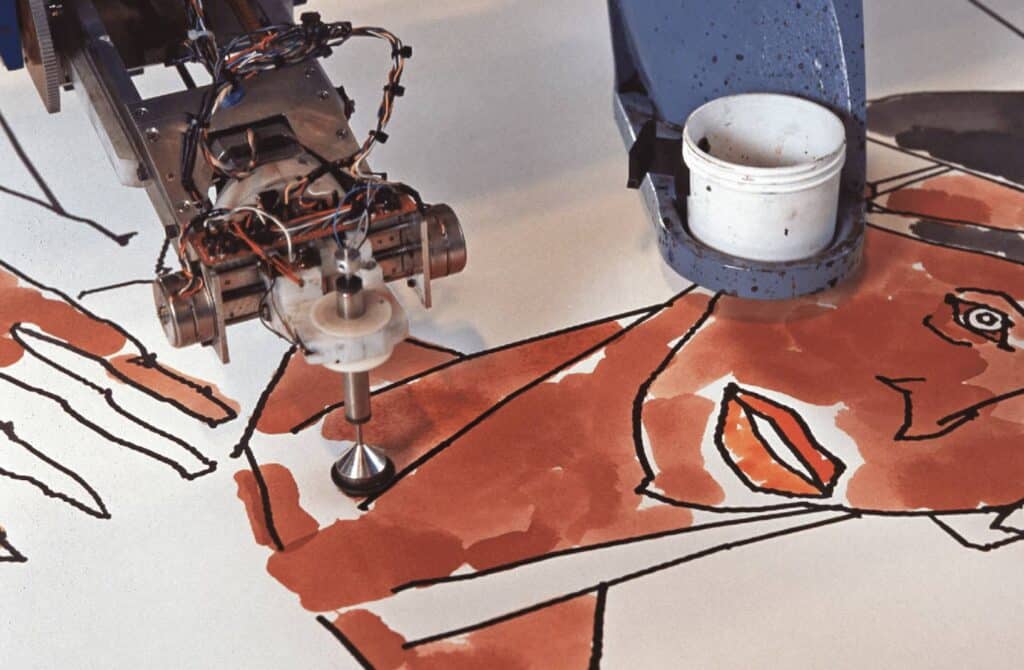
Although the commencement digital art experiences date back to the 1980s, its roots can be traced back to the 1960s with artists such every bit Frieder Nake, the grouping EAT (Experiments in Art and Technology), and Allan Kaprow exploring the relationship of human being and machine in the artistic realm and, especially the latter, envisioning a world of unbounded advice and interconnectedness. Similarly, in the 1970s pioneering video artist Nam June Paik envisioned a future of boundaryless communication and coined the iconic expression "electronic thruway." It was in the early 1980s, still, that an artist Harald Cohen with a group of engineerings invented a pigment program named AARON: a robotic machine designed to make large drawings on the canvass of newspaper placed on the flooring. Initially, the machine was creating abstract drawings, then those turned more representational over fourth dimension and the car was able to imitate shapes from nature. In the '90s, AARON also started to implement colour to the drawings. Even though Cohen was ever very conscientious non to claim AARON's inventiveness but rather his own, considering the motorcar just as a tool for his ain expression, his program is now considered as a harbinger of what nosotros know today as Artificial Intelligence.
In the 1990s, with the introduction of the personal computer, the improvements in digital technology, and the emergence of the internet, non only did these developments provide artists with farther creative liberty but also offered new ways to experience fine art with a growing involvement in the interactive nature of their creative output.
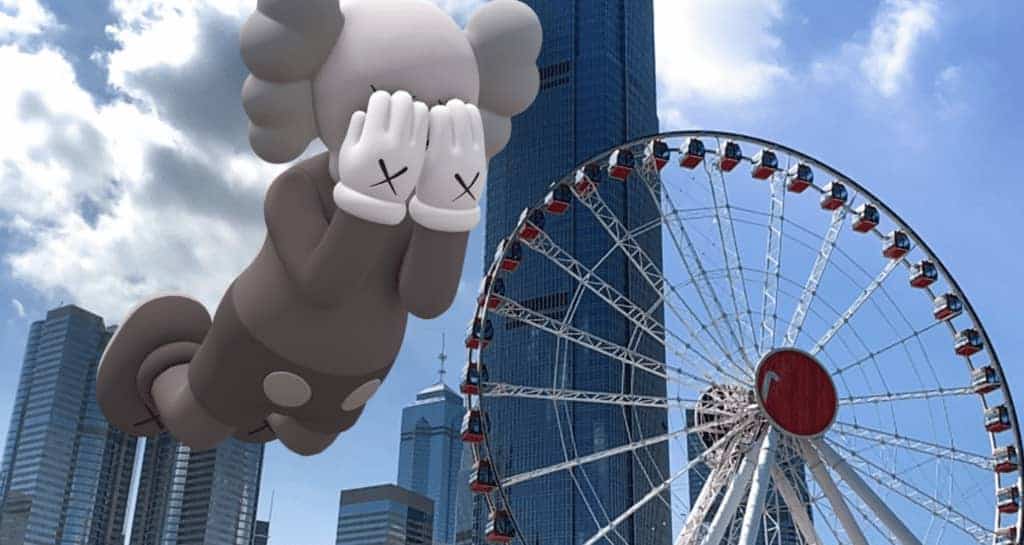
"When I realized the quality that could be achieved and experienced in AR, I was immediately drawn to its potential… I have been creating objects and exhibiting works in public spaces throughout my career, and this allows me to aggrandize on that in a whole new arena. The possibilities of locations and scale are endless, and I'm excited to outset a new dialogue in this medium."
Kaws
Bogus Intelligence
Compared to Cohen's early on creation, today's new developments incorporate AI and machine learning technologies. To create AI art, the artist chooses a ready of images to feed the algorithm. The algorithm then imitates the visual inputs producing a number of output images, which are ultimately selected and approved past the creative person. The algorithms used to produce art with this process are called GAN'southward (Generative Adversarial Networks), whereas the class of algorithms chosen AICAN (Bogus Intelligence Creative Adversarial Network) – one that is virtually autonomous in the creative process – works on two reverse forces: on the one stop, the algorithm is taught existing styles by memorizing their recognizable aesthetics; on the other, it gets penalized if, when producing a new artwork, as well closely imitates an existing piece of art. This principle ensures that the final result will exist innovative without going likewise far from what we already know. This class of algorithms is probable to build off more than recent trends in art history.
AI Artists
Mario Klingemann is one of the most well-known names in the AI art genre. In 2017, he created a serial of six prints using AI models, where he experimented with the inputs that feed the algorithm. For this work, the artist focused on the human trunk, grooming his AI models to explore posture past turning stick figures into paintings. For his painting The Butcher'southward Son, Klingemann was awarded the Lumen Prize as the best art created with technology.
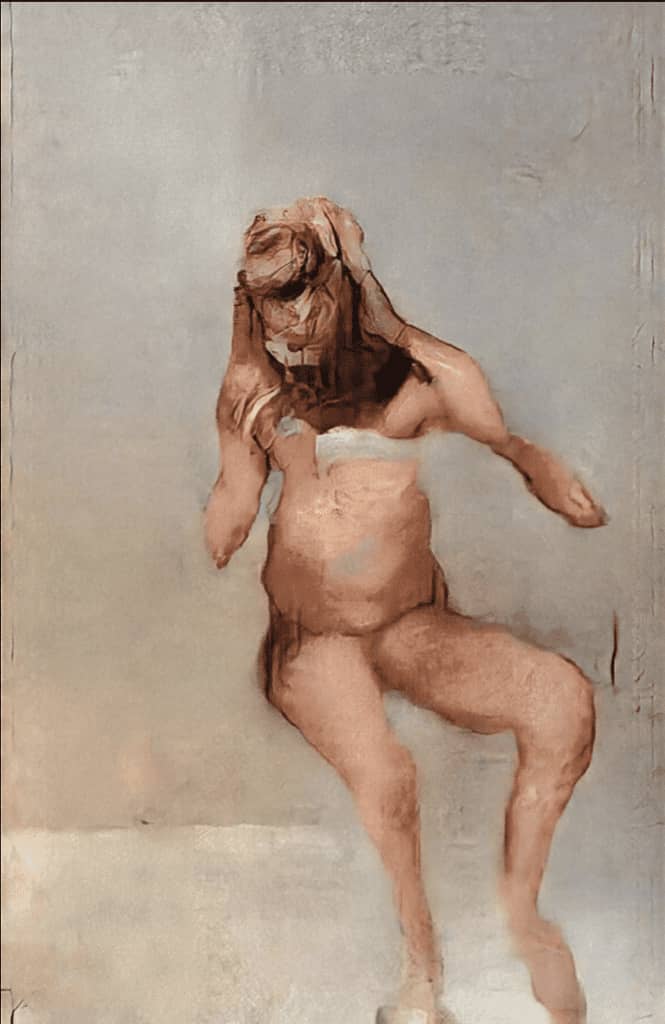
In 2018, a piece of work of art created by Edmond de Belamie with the help of an autonomous AI algorithm was auctioned for $432,500 at Christie's Auction House. Information technology was a human portrait generated by an algorithm that was fed with famous portraits from the history of art.
Another notable name in the spectrum of digital and AI art is Refk Andadol. He is a Turkish-American creative person known for his projects that consist of data-driven algorithms that create abstract and dream-similar environments. His latest projection called Motorcar Hallucinations: Nature Dreams is an ongoing exploration of data aesthetics based on collective visual memories of space, nature, and urban environments. Anadol and his team collect data from digital athenaeum and publicly available resources, then process the millions of photographic memories with machine learning models. The sorted images are and so clustered into thematic categories to better understand the semantic context of the information universe.
Artwork Preview | Refik Anadol, Car Hallucinations: Nature Dreams, 2021 | Part two
Augumented Reality
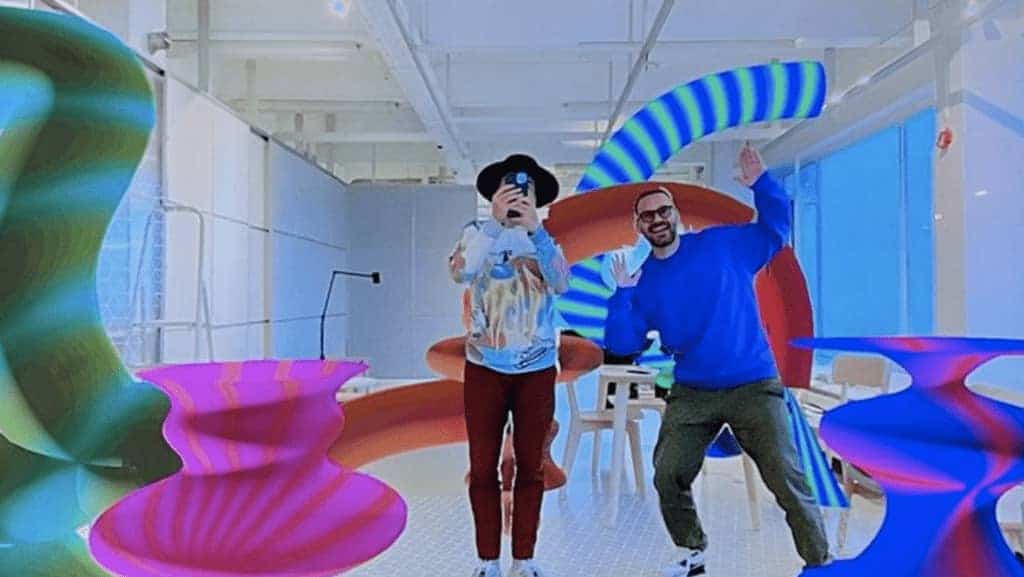
Augmented Reality (AR) is some other pop digital medium that gimmicky artists are using to express their creativity. Augmented reality involves an experience where the existent-life earth and the digital globe interact with each other. Real-world objects are enhanced past computer-generated perceptual information that is affecting sense. The primary value of augmented reality is the manner in which components of the digital world blend into a person's perception of the real world.
AR artists
Big names of the art scene incorporate AR in their exercise. But to mention a few, Olafur Elisson was using AR to bring rare natural objects into people's homes through the screen. Kaws exhibited 25 AR sculptures of his famous character Companion in metropolitan areas around the world during 2020, each piece was selling for approximately $10,000. Trevor Jones is a traditional painter using oil and canvass who started exploring digital layers to his paintings, firstly with painting QR codes and later past exploring AR. The creative duo Can&Ed has been using AR to animate their recognizable inflatable spatial installations in order to farther explore the relation of physical and digital and human being and the not-human, which is at the core of their creative inspiration.
The Market of Digital Art
Digital technology is continually opening up new perspectives for artistic experimentation. For artists who are willing to explore and play with new mediums, possibilities for artistic expression are endless. Moreover, digital fine art has radically changed the manner of viewing, enjoying, and sharing art every bit information technology can be easily transported and seen via dissimilar kinds of digital devices. The potential of a new, enlarged audience has too empowered artists to build their ain careers and brand their work known without the necessity of representation. But there is another contempo layer to digital fine art, one that explains the rising attention towards this kind of creative practice in the media more and more often with titles such as "Digital artwork sells for tape toll" or "The Nearly Expensive Digital Epitome Ever". This has something to do with the monetary value and the buying of digital art.
The development of blockchain engineering science, cryptocurrencies, and non-fungible tokens has allowed ownership over something that would otherwise exist impossible to own. That's how the marketplace for NFT'southward grew by nearly 300% in 2020 alone. NFT sales of crypto fine art and collectibles have already hitting an estimated $3.five billion in 2021 as reported in the Hiscox Art trade. Compared to the traditional art market place, the NFT market is offering certain benefits such as viability for digital works as fine art and assets, authenticity and transparency, more accurate, cheaper and quicker authentication, and royalties for hereafter sales – a context that sees artists in a much amend position compared to the traditional organisation where they earn no money from secondary market sales. However, the biggest revolution of NFT'southward in the art industry is related to the ownership of digital art. Even though many would contend that owning a piece of digital fine art is senseless with so many copies around, accessible to anybody, when information technology comes to the market place, owning an original slice of art, be it physical or digital, is associated with monetary and social value. Later all, having a print of a Picasso's painting is not quite the aforementioned equally owning the original painting. That is ultimately what makes the NFT art market so valuable.
Wondering where to offset?
Source: https://magazine.artland.com/digital-art/

Postar um comentário for "What Did Process Art Reintroduce to Art Practice in the Early 1970s?"