The Impact of E-Waste: NCEA Painting
Last Updated on February 8, 2017
This commodity features Michaela Barker's outstanding NCEA Level three Painting folio, completed in her last twelvemonth of loftier school at Waikato Diocesan Schoolhouse for Girls, Hamilton, New Zealand, 2012. Michaela was awarded Excellence for this project and her work was chosen to tour throughout New Zealand with the Top Fine art Exhibition. Michaela was as well awarded Scholarship for NCEA Level 3 Design and Dux of her schoolhouse.

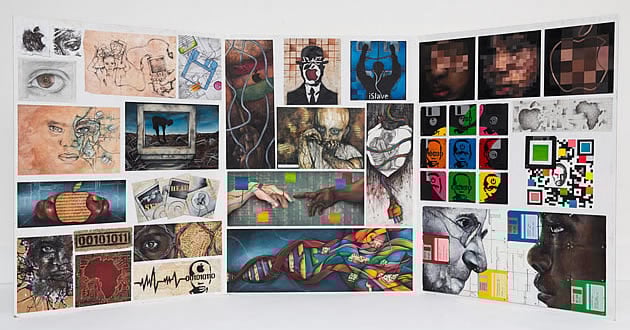
Through her portfolio exploration, Michaela has investigated advances in technology every bit well as raising sensation of some of the issues surrounding these advances. The idea of addressing gimmicky issues such as electronic waste (also known as east-waste) in her work came from a suggestion by her Painting teacher. Through art, various problems tin can be addressed. Michaela has addressed the current result of e-waste material too as the Fine art History concept of cribbing.

At the commencement of her project, Michaela focused on using a range of hands identifiable electronic items such as floppy disks, cell phones, iPhones, computer monitors and the earphones and wires associated with these devices. The image of the overlapping floppy disks (tiptop correct-hand corner of panel i) is reminiscent of the work past New Zealand artist Alexander Bartleet, who creates artworks out of waste material products.
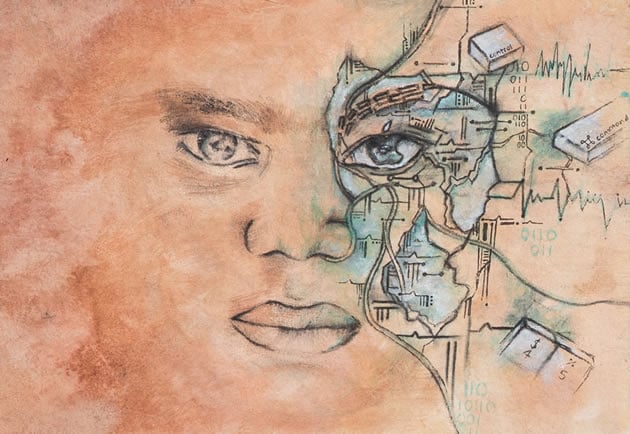
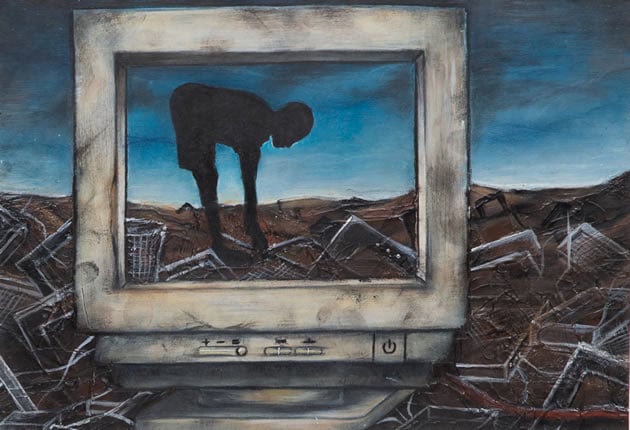
Throughout her portfolio investigation, as well as using electronic devices, Michaela has used diverse images that are symbolic of technology from advertising and contemporary fine art. The 'Apple' brand, while used widely as a symbol to represent engineering itself, has also aided in the development of the artworks. Pixelation is also a concept that is associated with applied science and digital imagery. The concept of pixelation links with the construction of the filigree that many of the paintings use, including the filigree that is formed by the use of foursquare floppy disks.

The second panel of the portfolio shows Michaela's intention to introduce more than colour into her paintings. Color is introduced through the pixels which are equanimous in the style of a floating filigree, and later the DNA helix. The colourful images link with the Andy Warhol inspired epitome on console three, through to the two final paintings. Color and pixels are both developed into final paintings on the third board. The middle painting on the acme row is an appropriation of Rene Magritte's The Son of Man. Hither Michaela has replaced the apple tree with the logo of the Apple make.

Appropriation in fine art has been used throughout history. Digital engineering science allows images to exist viewed and copied easily, and makes cribbing an of import issue in gimmicky art. With the aim of producing thought-provoking works, Michaela has appropriated images and iconography from a number of well-known artists and sources. The detail from Michelangelo's The Creation of Adam has been appropriated to create a powerful painting. The tension of this image is echoed in later works that look specifically at the contrast betwixt wealth and poverty.

A hit aspect of this portfolio investigation is how the artist has looked at the relationship between poverty alongside the advances in applied science. The contrast between these 2 worlds is significant.
Although the majority of the paintings were completed with acrylic paint on newspaper, this portfolio is a articulate instance of experimentation with a diverseness of materials. Newspaper towels were used as a fashion of creating an interesting surface to work on, as can be seen in some of the initial sketches on console one. Banksy has been an of import influence, both in terms of ideas and technique. Evidence of the employ of stencils and spray painting can be seen in a number of artworks. As an creative person who is an active vocalisation in getting people to talk over controversial problems, Banksy is an appropriate creative person to investigate for this body of work.
Other experimentation with materials includes ink pen and acrylic paint used on tracing paper. The tracing paper has then been placed on a recycled computer instruction manual to create layers.
Equally floppy disks are a redundant technological item, the use of e-waste product items as a painting surface is an appropriate and innovative medium. Nick Gentry has been used here as an artist model. The fact that the floppy disks have been used as subject matter and then subsequently as a painting surface in final images is an instance of the different ways that development tin exist shown through artworks and through ideas, every bit well every bit imagery and development of materials.

The systematic development of the body of work in a portfolio is important in creating a successful NCEA Painting submission in New Zealand. Throughout the year, Michaela photographed her paintings in one case they were created. She so used Photoshop to create a 'virtual folio'. This meant that she could visualise how her work was progressing and test how she wanted the paintings to exist laid out on the folio boards.
Planning was as well completed using Photoshop. Initial sketches for a limerick were sometimes fatigued on paper and and then later digitally manipulated in Photoshop to add in more details. Using the digital medium to manipulate compositions meant changes could be made with ease earlier the paintings were created on newspaper. The types of changes that were able to be made using Photoshop were things like trialling different colours and resizing parts of the proposed painting.

This article was written using information provided past Michaela Barker. If you enjoyed this art project, you may wish to view our other featured painting and drawing projects from high school students effectually the world!

This article was written by Maryann Darmody. Maryann has a Bachelor of Fine Arts, Bachelor of Arts and a Postal service Graduate Diploma of Pedagogy, with additional papers completed in Architecture, Design and Interior Blueprint. She is currently a NCEA Visual Art teacher at a secondary schoolhouse in New Zealand and has taught NCEA Art History online for iv years.
Source: https://www.studentartguide.com/featured/impact-e-waste-ncea-painting

Postar um comentário for "The Impact of E-Waste: NCEA Painting"